
1. What is the Surfliner Inn Project?
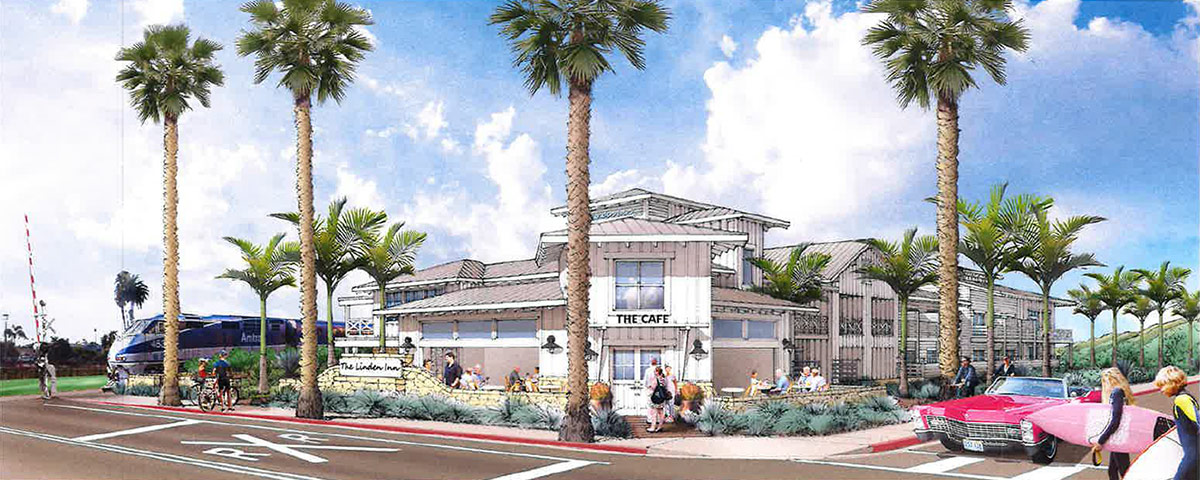
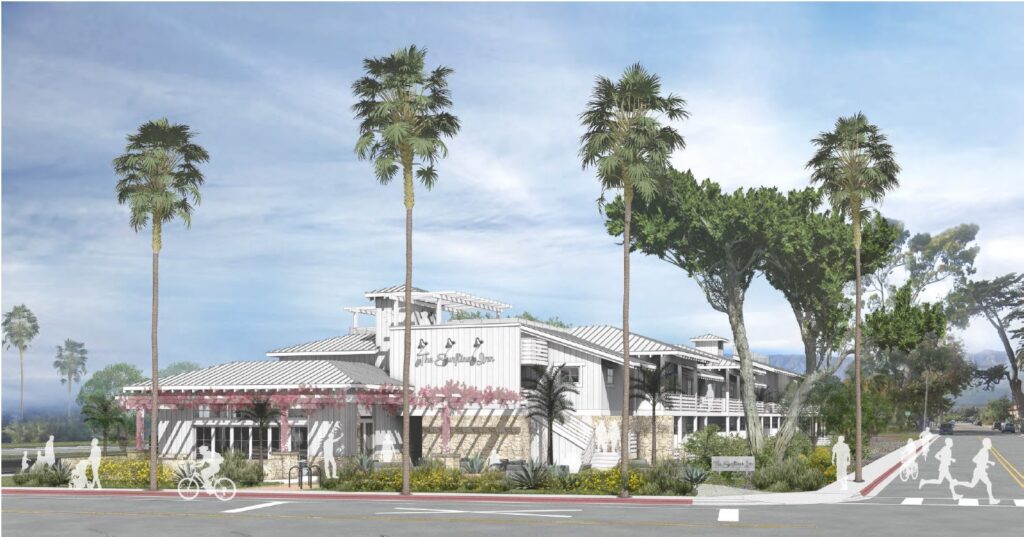
The Surfliner Inn Project (Project) is a proposed development project that includes a commercial hotel and public improvements. Specifically, the Project includes a 36-room hotel development that would contain a mix of guest rooms and amenities such as a café/restaurant, rooftop lounge, and a potential event space. The Project also includes plans for new public parking, improved coastal trail access, and enhanced landscaping.
The hotel portion of the Project would be located on the eastern portion of City Parking Lot #3 (i.e., 499 Linden Avenue), nearest the Linden Avenue and Fifth Street intersection. The parking, improved coastal trail access, and enhanced landscaping would be located at City Parking Lots #3 and #4.
Please see the proposed site plan, below, for an illustration of the proposed Project location and primary elements.
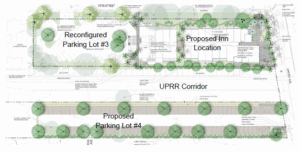 City Parking Lots #3 and 4, are referred to in these FAQs as the Project Site.
2. What spurred this Project?
A two-story Southern Pacific Railroad building, which was razed in the late 1960s, was formerly located on what is now Parking Lot #3. The interest in pursuing a replacement building was spurred by additional land acquisitions by the City along the railroad corridor in 2012 and 2013, which prompted a desire to study and consider options for landscaping and beatification, pedestrian amenities, parking, tourist accommodation, and public park improvements on these City-owned parcels. The City Council and staff work plan workshop held in January 2015 included a presentation of an initiative to further analyze potential improvements to this area, including an inn and restaurant at the site, which the Council approved as part of the work plan and directed staff to pursue.
The Project represents the culmination of a multi-year effort by the City to put a portion of the underutilized Parking Lot #3 to a beneficial use. Being adjacent to the Amtrak station, the City’s commercial core, and outdoor recreation, the site is ideally situated for a small-scale, visitor-serving use. Economic studies have identified a lack of small-scale lodging within walking distance of downtown which has historically resulted in a loss of visitor spending and underutilization of downtown businesses, particularly outside peak hours.
Visitor-serving lodging located in and adjacent to the downtown commercial core is consistent with General Plan objectives and policies that prioritize visitor-serving commercial uses, direct commercial development to established downtown areas, and support economic vitality while preserving Carpinteria’s small-town character (General Plan Objectives LU-3 and LU-5; Policies LU-3d, LU-3e, LU-3g, and LU-5a).
The ground lease model provides ongoing public income through transient occupancy taxes and ground-lease payments, as well as other public benefits, including enhanced public restrooms and trail improvements, which are part of the conditions of approval for the Inn. This model also gives the City greater control over the Inn’s use and design, lease terms, and revenue sharing. Parking will continue to be available to the general public in a new parking lot that will be constructed across the railroad tracks resulting in a minimal net loss of spaces overall.
3. How did the City select 499 Linden Managers, LLC as the developer for the Project?
In late 2017, the City Council directed staff to publish a Request for Proposals (RFP) to select a private developer to develop and operate a boutique hotel on a portion of City Parking Lot #3. Staff issued the RFP and accepted responses until July 9, 2018. City Council then authorized the Public Facility Site Acquisition/Development Committee (Committee) to evaluate responses received by the City and to return to the City Council with a recommendation for proceeding.
The City received two responses to the RFP and met with the Mian Group on August 9, 2018, and The Theimer Group on September 5, 2018. Both respondents were provided a list of questions in advance of their meeting with the City. While both respondents expressed an interest in leasing the land and constructing a boutique hotel, only The Theimer Group provided written responses to the City’s questions. Following these meetings, staff conducted a thorough evaluation of the two proposals and recommended that the City Council select The Theimer Group. The Theimer Group’s response was formally considered and accepted by the City Council at its November 13, 2018 meeting.
From there, the City and The Theimer Group entered into an Exclusive Negotiation Agreement (ENA), which was approved by the City Council on June 24, 2019. Consistent with the terms of the ENA, The Theimer Group assigned its interest to 499 Linden Managers, LLC (Developer), a legal entity comprised of the same majority beneficial interest owners as The Theimer Group. Following this assignment, the City entered into a Lease Development and Disposition Agreement (LDDA) with the Developer in 2021, which is still in effect today. Details of the City’s consideration and approval of the LDDA are available on the Surfliner Inn Project – City of Carpinteria website.
The LDDA imposes certain conditions on the Developer, including following the City’s standard development review process (e.g., review by the Architectural Review Board (ARB) and Planning Commission). If and when the conditions are met, the Developer and City will execute a ground lease (which has already been negotiated and is attached to the LDDA as an exhibit). Under the terms of this ground lease, the Developer would then construct and operate the Project.
4. What is the City’s discretion under the LDDA? Can the City terminate the LDDA or refuse to enter into the ground lease for any reason?
The LDDA, among other things, outlines the conditions that the Developer would need to meet for the City to execute a ground lease for the Project. If the Developer satisfies the conditions in the LDDA, then the City Council must execute the ground lease. If the Developer does not satisfy these conditions, then the City Council may not execute the ground lease. In other words, the LDDA is similar to any other lease between a tenant and landlord that sets forth certain conditions that the potential tenant (e.g., the Developer) must satisfy (e.g., compliance with the City’s standard development review process and other appliable laws and regulations, payment of deposits, tenant improvements, insurance coverage) and conditions that the landlord (e.g., City) must satisfy (e.g., any landlord improvements, delivery of the premises) before the lease starts.
As referenced above, an important condition in the LDDA is that the Developer must obtain all City land use entitlements through the City’s standard development review process. The City retains full discretion to review and consider the Project under its land use authority and obligations under applicable California law. This means that the City can review and approve, conditionally approve, or disapprove the Project based on the evidence before City decisionmakers (e.g., Planning Commission). When the development review process is finished, the City Council will review and determine whether all of the conditions in the LDDA are satisfied. If so, the City will sign the ground lease.
5. Who is paying for the Project? Who receives revenue from the Project?
All costs to develop the Project are the responsibility of the Developer. If and when the Project is developed, the Developer will receive revenue from guests staying at the hotel, eating meals at the café, etc. The City will receive lease payments from the Developer under the ground lease plus other revenues such as transient occupancy taxes, sales taxes, and property taxes. A Hotel Financial Analysis and a Final Market Conditions study were completed in 2016 and can be found on the Surfliner Inn Project – City of Carpinteria website. Please note that the financial figures in these reports are outdated and do not accurately reflect the actual revenues the City will receive.
6. Has the City held open, transparent meetings regarding the planning and development process for this Project and provided opportunities for public input?
Yes. Both the process that the City Council engaged in to make the Project Site available for development of the hotel and related amenities, and the City’s standard development review process (e.g., review by the ARB and Planning Commission) overseen by the Community Development Department to review the development application will take place in open and public meetings subject to the Brown Act.
To date, some of the key public meetings regarding the Project include:
• August 14, 2017 – City Council Meeting – Authorize Issuance of RFP to Select Developer
• November 13, 2018 – City Council Meeting – Select Developer and Authorize Negotiation of Exclusive Negotiation Agreement
• July 24, 2019 – City Council Meeting – Execute Exclusive Negotiation Agreement with The Theimer Group (now 499 Linden Managers, LLC)
• November 20, 2020 – Joint City Council / Planning Commission / ARB – Conceptual Review
• July 19, 2021 – City Council Meeting – Execute LDDA
• November 29, 2021 – City Council Meeting – Acceptance of the Project Plans and Authorization to Proceed with the Development Plan / Coastal Development Permit Application to the Community Development Department
• December 12, 2024 – ARB – Preliminary Review
• June 16, 2025 – Environmental Scoping Scoping Meeting
Staff will endeavor to update the above list as the Project progresses through the City’s standard development review process. In the meantime, a full listing of previous City Council, Planning Commission and ARB public meeting proceedings is summarized here: Surfliner Inn Project – City of Carpinteria.
7. How will this Project impact the City’s unique “beach town charm”? What measures are in place to minimize potential increases in noise and disturbance from the Project and preserve the community's character?
The Project’s Development Plan / Coastal Development Permit application is subject to all City Municipal Code (CMC) regulations and General Plan/Coastal Land Use Plan policies. The Project is also required to be reviewed by the City’s Planning Commission to confirm that the Project follows all State and Local Laws, CMC regulations, development policies, and California Environmental Quality Act (CEQA) requirements.
In order to approve a Project, the Planning Commission must be able to make certain findings, including but not limited to, confirming the Project would not cause substantial environmental damage, would not adversely affect community services (e.g., public safety), would avoid risks to life and property, and would not be detrimental to the peace, health, safety, and general welfare of the surrounding area.
As part of the development review process, the City’s ARB reviews proposed projects and serves as an advisory body to the Planning Commission (and City Council on appeal) as it relates to site design, aesthetics, architecture, lighting, signage and landscape review. The ARB is responsible for making a recommendation as to whether the proposed Project is consistent with the City’s design criteria as spelled out in Title 14 (“Zoning”) of the CMC and the applicable design-related policies of the City’s General Plan/Coastal Land Use Plan.
An action by the Planning Commission to approve or deny the Project may be appealed to the City Council. Therefore, the City Council is the ultimate decisionmaker on the Project to confirm that the Project is compatible with the unique qualities of the City.
8. How will the Project address concerns about increased traffic congestion, insufficient parking, and potential impacts on local residents?
Traffic and Parking Study: As part of the City’s standard development review process, the Developer prepared technical studies to evaluate the Project’s potential impact to the environment and the community. Included in these studies is a Traffic and Parking Study prepared by Associated Transportation Engineers (ATE) which analyzed the future traffic and parking impacts of the Project should it be approved and built. The study was peer-reviewed by the City’s contract Traffic Engineer and Public Works Department staff to confirm the proposed 139 spaces provided by the Project would satisfy the projected parking demand.
Parking Supply and Demand: The ATE Traffic and Parking Study indicates that the existing Parking Lot 3 contains 113 spaces. With the construction of the Project, this lot would be reconfigured to provide 46 spaces, resulting in a net loss of 67 spaces. To offset this reduction, the Project proposes constructing a new City Parking Lot #4 south of the Union Pacific Railroad (UPRR) tracks, offering 93 spaces. Combined, City Parking Lot #3 and #4 will provide a total of 139 parking spaces, which is an increase of 26 spaces over the current availability. The study’s shared parking demand analysis, based on Urban Land Institute (ULI) methodologies, estimates that the peak parking demand for the Project will be 56 spaces on weekdays and 54 spaces on weekends. Therefore, the combined parking facilities will adequately meet and exceed the Project’s peak parking requirements, while continuing to provide parking availability for other downtown and beach area uses.
Ingress/Egress Safety: Community concerns have been raised regarding the safety of the single driveway access to City Parking Lot #4 from Linden Avenue, especially given its proximity to the railroad tracks and a busy pedestrian crosswalk. The study evaluated this ingress and egress point and found that the City Parking Lot #4 driveway is expected to operate at a Level of Service (LOS) A, indicating minimal delays and queuing for vehicles entering and exiting. The analysis also noted sufficient storage space for two vehicles between the stop bar at the rail crossing arm and the driveway, ensuring safety and efficiency. Project design features and measures, such as appropriate signage and pavement markings, will be implemented to enhance both vehicular and pedestrian safety in this area.
Proximity to Private Residences: The placement of City Parking Lot #4 near private residences has been a point of concern for potential impacts on neighboring properties. To address this, the Project design incorporates several planning strategies:
• Landscaping Buffers: Strategically placed landscaping will serve as a visual barrier between City Parking Lot #4 and adjacent residences.
• Lighting Design: Lighting fixtures will be designed and positioned to prevent light spillover onto neighboring properties, ensuring that illumination is contained within the parking area.
• Operational Guidelines: The Project will implement operational measures to minimize noise and disturbances, particularly during early morning and late evening hours.
These measures aim to minimize potential adverse effects on local residents and maintain the community’s quality of life.
The City remains committed to ongoing monitoring and collaboration with the community to address any additional concerns that may arise during the Project’s development and operation. Project alternatives will also be considered as part of the CEQA process.
9. How does the Project's height and size impact the surrounding area in terms of visual compatibility and overall character? How is the City addressing concerns about the Project’s scale relative to existing structures?
Height and size of new development is governed by development standards in the CMC and applicable design-related policies of the City’s General Plan/Coastal Land Use Plan. As currently proposed, the Project meets all applicable requirements with respect to overall height, lot coverage, setbacks and related development standards.
To elaborate, the current Project was reviewed by the City’s ARB on December 12, 2024. The ARB’s role in the review of the proposed Project is that of an advisory body to the Planning Commission (and City Council on appeal) as it relates to site design, aesthetics, architecture, lighting, signage and landscape review. The ARB is responsible for making a recommendation as to whether the proposed Project is consistent with the City’s design criteria in Title 14 (“Zoning”) of the CMC and applicable design-related policies of the City’s General Plan/Coastal Land Use Plan. As a part of the its deliberations, the ARB receives comments provided by members of the public. At the December 12, 2024 meeting, the ARB reviewed the current Project plans, reviewed 34 written comments and heard from 32 interested members of the public. The ARB recommended preliminary approval of the Project to the Planning Commission by a unanimous vote and provided the applicant and City staff with a number of comments, including further study of the southeast corner of the Project Site, further detailing of the proposed landscaping and lighting, further study of the Project’s Fifth Street massing, and further study to incorporate additional landscaping and a sound wall along the southern boundary of the proposed City Parking Lot #4. A copy of the ARB staff report and plans, along with a video replay of the December 12, 2024 ARB meeting, can be found here: Agendas & Meetings – City of Carpinteria.
The environmental review process under CEQA will also include an analysis of the Project’s potential impacts to aesthetics and visual resources (which are tied to height/size of the development), and if potential impacts are identified, can recommend mitigation measures to help address those impacts.
10. How is the City addressing environmental impacts such as water usage, stormwater runoff, effects on green space, and other potential environmental concerns?
The City is committed to ensuring that the Project is designed and evaluated with environmental sustainability in mind. As with any new development, the Project will be required to comply with California’s stringent Building Code standards, which incorporate energy efficiency, water conservation, and green building practices. To the extent the Project incorporates additional sustainable features beyond what is required by Code, those elements will be highlighted as part of the development review process.
The City will also rely on the CEQA process for evaluating and addressing the Project’s potential environmental impacts. Through CEQA, the City will conduct a comprehensive review to identify, analyze, and assess the significance of potential environmental effects across key areas such as water usage, stormwater runoff, impacts on green space, noise, transportation, safety and other environmental considerations.
As part of the CEQA process, an Environmental Impact Report (EIR) will be prepared, which will:
• Identify and quantify potential environmental impacts, using established thresholds of significance.
• Evaluate feasible mitigation measures to reduce the severity of any significant environmental effects.
• Consider Project alternatives that may further minimize impacts while maintaining Project objectives.
The EIR process provides opportunities for public input and review (see response to #12 below), ensuring that community concerns about the Project’s potential environmental effects are fully considered. Ultimately, this process will guide the City in making an informed decision on the Project while balancing economic development with environmental responsibility.
11. How is the City ensuring this Project complies with the Surplus Land Act?
The City Attorney’s Office has analyzed the Project’s compliance with the California Surplus Land Act (SLA) (set forth in Government Code sections 52440 et seq.) and has determined the City is in compliance with all facets of this state law. The City has also received confirmation from the California Department of Housing and Community Development (HCD) that the City is in full compliance with the SLA in relation to the Project, so long as the ground lease is executed by the applicable statutory deadline. The formal confirmation letter from HCD is available HERE.
The City remains committed to transparency and adherence to the SLA.
12. What is the current stage of the Project in the development review process, and what are the next steps?
The Project application has been deemed “complete,” meaning that the Community Development Department has received sufficient information from the Project applicant to begin environmental review pursuant to CEQA and prepare a detailed analysis of the Project’s compliance with all relevant CMC regulations and General Plan/Coastal Land Use Plan policies.
With respect to CEQA, the Project requires preparation of an EIR prior to any decision on the Project by the Planning Commission. A qualified environmental consulting firm, selected by the City, will prepare the EIR with collaboration and input from City staff. The developer is responsible for reimbursing the City for all costs associated with preparation of the EIR, including but not limited to, hiring the EIR consultant, city staff and city attorney time.
A brief summary of EIR process is depicted in this flowchart:

As part of the EIR process, a Notice of Preparation (NOP) is circulated for 30 days and a public scoping meeting is held to solicit input on potential environmental effects that should be considered and evaluated as part of the EIR. City staff then works with the EIR consultants to prepare a Draft EIR. Once completed, the Draft EIR is circulated for public review and comment for 45 days, during which a public meeting is held with the City’s Environmental Review Committee (ERC) to discuss the Draft EIR and answer questions.
Following the end of the public review period for the Draft EIR, a proposed Final EIR is prepared. The Proposed Final EIR includes responses to substantive comments received, along with any necessary changes to respond to comments received during the public draft review period. The EIR process generally takes six to twelve months.
Upon completion of the Proposed Final EIR, the Project is scheduled for a noticed public hearing before the Planning Commission. The Planning Commission considers whether to certify the EIR as having satisfied the requirements of CEQA and renders a decision on whether the Project is consistent with the zoning regulations pursuant to Title 14 (“Zoning”) of the CMC and applicable policies of the City’s General Plan/Coastal Land Use Plan.
If you would like to be added to the Interested Parties List to receive all notices for this project, please email Principal Planner Mindy Fogg at mindyf@carpinteriaca.gov.
13. What was Measure T2022 and how did it relate to the Surfliner Inn Project?
Measure T2022 was a citizen-sponsored initiative that appeared on the City’s November 2022 general election ballot. Titled by its proponents as the “Save Our Downtown and Beach Parking Lot Initiative,” the measure asked voters to amend the City’s General Plan and zoning regulations to make the proposed Surfliner Inn Project (“Project”) incompatible with underlying land use regulations.
Specifically, Measure T2022 sought to:
- Change the land use and zoning designations for the City-owned parcel at 499 Linden Avenue (commonly known as City Parking Lot #3) from Commercial Planned Development to Open Space/Recreation (OSR).
- Amend the OSR land use category to:
- Permit residential overlays, and
- Limit parking uses on OSR-designated parcels to “existing parking” only, which could be interpreted as limiting the ability to add new parking on such parcels, depending on how the amended definition is applied.
If approved by a majority of the City’s voters, the measure would have effectively prohibited the Project from proceeding through the City’s standard development review process.
Measure T2022 appeared on the ballot as follows:
“Shall the Measure to Change and/or Readopt the City of Carpinteria’s General Plan Designation and Zoning Designation for Two Parcels of City-Owned Property (APN 004-105-011 and APN 004-105-026) Located Adjacent to the Railroad Tracks to the West of Linden Avenue and to Amend the Definition of the Open Space/Recreation (OSR) Land Use Category of the General Plan Land Use Element be adopted?”
A “yes” vote on Measure T2022 would have approved the proposed measure (and made the Project incompatible with the City’s underlying land use regulations). A “no” vote on Measure T2022 would maintain the City’s existing land use designations, allowing for the Project to proceed through the City’s standard development review process.
A simple majority vote was required, and ultimately, the City’s voters did not approve Measure T2022. The final vote was 50.82% voting against and 49.18% voting in favor. As a result, the Project was allowed to continue through the City’s standard development review process.
A copy of the full initiative measure and the City Attorney’s impartial analysis are available at the links below.
14. What agreements has the City entered into with 499 Linden Managers, LLC and what do these agreements mean for the Project? How does the review process work for the Project?
The City has entered into two agreements related to the Project: 1) an Exclusive Negotiation Agreement (“ENA”), and 2) a Lease Disposition and Development Agreement (“LDDA”). These two agreements help organize the process for the Project, protect the City’s interest, and establish conditions that must be satisfied by the Developer before any approval or construction may occur. Copies of the ENA and LDDA are available on the Surfliner Inn Project – City of Carpinteria website.
The ENA was originally entered into with the predecessor entity to 499 Linden Managers, LLC (“Developer”) (see FAQ: “How did the City select 499 Linden Managers, LLC?” for more details). This time-limited agreement gave the City and the Developer time to negotiate the details of a potential project. The ENA did not approve the Project nor guarantee that it would be built. Instead, it set an exclusive period for negotiations where the parties agreed to not negotiate with other developers. Following the successful negotiations with the Developer, City Council authorized the City to continue working with the Developer for purposes of entitlement processing and further agreement negotiations.
The City and the Developer then entered into the LDDA, which outlines the project scope and the specific conditions that must be met for the Project to proceed. For example, the LDDA specifies the City’s and Developer’s respective responsibilities and sets forth insurance and financing requirements, among others. The City enters into these types of agreements to protect the City’s interests and ensure that developers commit to specific conditions.
It is important to understand that these agreements do not mean that the Project is approved. The Developer must first meet certain conditions under the LDDA and still go through the City’s development review process, which includes submission of a complete project application that is subject to multiple reviews by the City. In addition, the City is required to evaluate potential environmental impacts under CEQA before the Project can be approved.
If the Project and the associated environmental impact report are approved, and all conditions precedent in the LDDA have been satisfied, the City may enter into the ground lease with the Developer (which has already been negotiated and is attached to the LDDA as an exhibit). Under the terms of this ground lease, the Developer would then construct and operate the Project and pay rent to the City. (See FAQ: “Who is paying for the Project? Who receives revenue from the Project?” for more details).
15. How is the City ensuring that 499 Linden Managers, LLC has the financial wherewithal for the Project?
The LDDA includes multiple provisions to ensure that the Developer has the financial capacity to complete the Project. For example, before construction can even begin, the Developer must provide proof of financing, demonstrate sufficient equity and debt funding, secure surety bonds covering the full construction cost, and execute a guaranty agreement approved by the City. The Developer is also required to obtain and maintain comprehensive insurance coverage.
All of these conditions must be satisfied before the ground lease is executed, and as a result the Developer cannot start work on the Project without verified financial backing and guarantees. In addition, the LDDA includes a specific provision that covers the Developer’s failure to complete the Project. These measures protect the community and minimize the risk of an unfinished project.
 © 2026 City of Carpinteria. All Rights Reserved.