
How has the California Legislature changed housing law in the last decade?
- Over the past decade, the California Legislature has passed hundreds of laws to streamline housing development. Many of these laws are designed to limit local agencies’ ability to deny or reduce the density of housing projects.
- Most notably, the Legislature significantly strengthened the Housing Accountability Act (Government Code § 65589.5) (HAA), which now applies broadly to most housing development projects statewide. The HAA limits a local agency’s ability to deny, reduce the density of, or impose conditions that render housing projects infeasible when those projects comply with applicable, objective development standards, unless the city can make specific health and safety justifications to do so.
- The State strengthened requirements for cities and counties to realistically plan for new residential development through their respective Housing Elements, which is a component of the General Plan. Housing Elements must establish goals, policies, quantified objectives, financial resources, and a schedule for programs to preserve, improve, and develop housing. Local agencies also must develop an inventory of sites and, if necessary, rezone additional sites to accommodate their regional housing needs for all income levels. Relatedly, the Legislature also has limited local agencies’ authority to enact new policies or regulations that reduce a property’s capacity for residential development or impose a ban on new housing development.
- The State also enacted various streamlining entitlement pathways for various types of housing development projects, including for qualifying multifamily housing projects (Senate Bill (SB) 35, SB 423); certain multifamily housing projects in commercial zones (SB 6, Assembly Bill (AB) 2011); accessory dwelling units (ADUs) and duplexes and/or lot splits (SB 9), and small-scale subdivisions (SB 684, SB 1123).
- The State passed a related bill that prohibits a local agency from imposing minimum parking requirements for residential, commercial, and most other projects located within a ½ mile of public transit, except under specific circumstances (AB 2097). The only qualifying transit station in the City is the Carpinteria Train Station.
- The State expanded application of State Density Bonus Law in the California Coastal Zone and required that local agencies harmonize State Density Bonus Law and the Coastal Act (AB 2797). California’s Density Bonus Law (Government Code §§ 65915–65918) requires local governments to grant developers increased density (up to 50% or more), concessions/incentives, waivers/reductions in development standards, and specified parking ratios for projects that include affordable housing. It applies to projects with 5+ units that provide a percentage of the units for lower or moderate income housing.
- To ensure local agencies comply with these new housing laws, the Legislature also empowered the California Department of Housing and Community Development (HCD), the Attorney General, and the courts with additional enforcement tools including awarding applicants attorneys’ fees if they prevail in litigation related to a denial, imposing penalties on a local agency for noncompliance, and supplanting a local agency’s land use authority.
What is the City’s Regional Housing Needs Allocation?
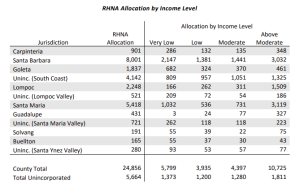
- The California Department of Housing and Community Development (HCD) determines the number of housing units that regions statewide must accommodate and for which they must plan to satisfy their respective Regional Housing Needs Allocation (RHNA) on an 8 year cycle. In practice, the RHNA is the City’s state-assigned share of the region’s housing need by income level for a given Housing Element cycle.
- HCD first determines how much housing each region needs, then a regional agency—locally the Santa Barbara County Association of Governments (SBCAG) —allocates that need among its cities and counties. Finally, each local government updates its Housing Element to show how it can accommodate its assigned number, either through its existing zoning or through planning actions such as rezones or upzones that allow for more housing.
- The RHNA for each jurisdiction within Santa Barbara County, including the City of Carpinteria, is below:
What is the City’s Housing Element?
- A Housing Element is a mandatory component of a local agency’s General Plan. Housing Element Law directs cities and counties to plan for their current and future housing needs for each economic segment of the community and persons with special needs. A Housing Element explains the community’s housing needs, opportunities and constraints, impediments to fair housing, as well as policies, programs and quantified objectives to facilitate the construction, rehabilitation, and preservation of housing. Housing Elements also must include programs, policies and quantified objectives that affirmatively further fair housing—such as combating housing discrimination, reducing segregation, and eliminating disparities in housing opportunity—throughout the agency’s jurisdiction.
- Housing Elements must be updated every eight years, also known as the Housing Element cycle. The current sixth cycle runs from 2023–2031. A Housing Element also documents how a city or county can accommodate its state‑assigned Regional Housing Needs Allocation (RHNA) during this period. Local governments must provide opportunities for housing development to accommodate its RHNA, in part, by enabling the private market and nonprofit housing providers to build housing for all segments of the community.
What is the Builder’s Remedy?
- The Builder’s Remedy is a legal tool that allows housing developers to bypass local zoning and general plan requirements when a city or county’s housing element is not in substantial compliance with state law. The Builder’s Remedy represents one specific application of the broader protections established under HAA. As discussed above, the HAA provides that local agencies may only deny or reduce the density of certain qualifying affordable housing development projects if the agency is able to make certain findings. One such finding is that a local agency may deny a qualifying housing project if the project is inconsistent with the jurisdiction’s general plan or zoning ordinance and the local agency has adopted a housing element in substantial compliance with State Housing Element Law (Gov. Code § 65580 et seq.). If a Housing Element is out of compliance at the time that the local agency acts on the application or the applicant submitted a preliminary application when the local agency was out of compliance, however, the local agency is barred from denying, reducing the density of, or rendering infeasible a qualifying project based on inconsistencies with the agency’s general plan or zoning ordinance. This resulting limited discretion is commonly referred to as the “Builder’s Remedy.”
- In some cases, however, a local agency may be able to deny a “Builder’s Remedy” project if it can make one of the other findings in the Housing Accountability Act.
What is the California Environmental Quality Act (CEQA)?
- CEQA is a state statute that requires state and local agencies to analyze and disclose the potentially significant environmental impacts of their actions and avoid or mitigate those impacts as feasible. CEQA was passed to better inform governmental decision makers and the public about significant environmental effects of proposed activities to identify ways that environmental impacts can be reduced. CEQA applies to any project, activity or discretionary action carried out by a government agency that could cause a physical change to the environment.
- If CEQA applies to the project, the lead agency first determines whether a statutory or categorical exemption applies to the project. Statutory exemptions are projects that have been completely excluded from CEQA by the legislature, regardless of impacts, while categorical exemptions are described in CEQA Guidelines and apply to entire classes of projects. If an exemption does not apply, the lead agency must prepare and certify a negative declaration (ND), mitigated negative declaration (MND) or environmental impact report (EIR) depending on whether the project will result in potentially significant impacts and whether those impacts can be mitigated to a level of insignificance. Most importantly, CEQA review entails a substantial public process that includes mandatory public hearings and receipt and review of public comment.
- CEQA applies to most housing development projects. Some recent laws, however, have created new exemptions or made certain qualifying projects ministerial—i.e., involving no exercise of agency discretion—to streamline or eliminate CEQA review for housing projects (AB 130, SB 131). These new streamlining tools generally only apply within developed areas and on sites without environmental constraints.
What is the California Coastal Act?
- The California Coastal Act was enacted in 1976 to enhance public access to the shoreline, protect coastal natural resources, and balance the interests of development with those of conservation. The Coastal Act guides what can be built in the coastal zone through a regulatory scheme managed by the Coastal Commission in partnership with local, state, federal, nongovernmental, and private stakeholders. Development within the coastal zone requires a coastal development permit issued by the Coastal Commission or a local government entity. Under the Coastal Act, development includes typical land development activities and construction, but also includes changes in the intensity of land or water use.
- When enacting the Coastal Act, the Legislature recognized that coastal conservation could contribute to worsening gentrification and a general increase in home values. The Coastal Act included broad policy language requiring affordable housing within the coastal zone for persons of low and moderate incomes. Around 1982, however, the Legislature amended the Coastal Act to no longer authorize the Coastal Commission to require affordable housing. In the early 2000s, the Legislature amended the Coastal Act again to encourage affordable housing by supporting it, including density bonuses, unless there is a conflict with Coastal Act policies, and to strengthen protections for existing affordable housing opportunities for persons of low and moderate incomes in the coastal zone.
- Importantly, some housing laws contain a “Coastal Act savings” clause, which state that the Coastal Act continues to apply to housing projects in the coastal zone. As a result, coastal cities are often tasked with attempting to harmonize potential conflicts between state housing laws and the Coastal Act.
- The City of Carpinteria is entirely within the California coastal zone and its certified Local Coastal Program implements the Coastal Act within its boundaries.
What about protections for existing units?
- The Mello Act (1982) helps preserve the affordable housing supply in California’s coastal zone. The Mello Act requires that projects on sites with affordable dwelling units replace those units with new affordable units wherever feasible. In practice, the Mello Act means that coastal cities may not approve the demolition or conversion of low or moderate income households units, unless replacement affordable homes are provided in the same city within a specified period of time.
- The Housing Crisis Act of 2019 also expanded protections for existing “protected units” by requiring that new housing development projects not reduce the total units as part of a housing project, and include the same number or more affordable units. Existing occupants also receive certain protections including the right to continue to occupy the unit until development starts, and occupants that are lower income households receive relocation assistance and the right to occupy an affordable unit in the new development.
 © 2026 City of Carpinteria. All Rights Reserved.